Region
Switzerland
Switzerland
Switzerland
National thesis
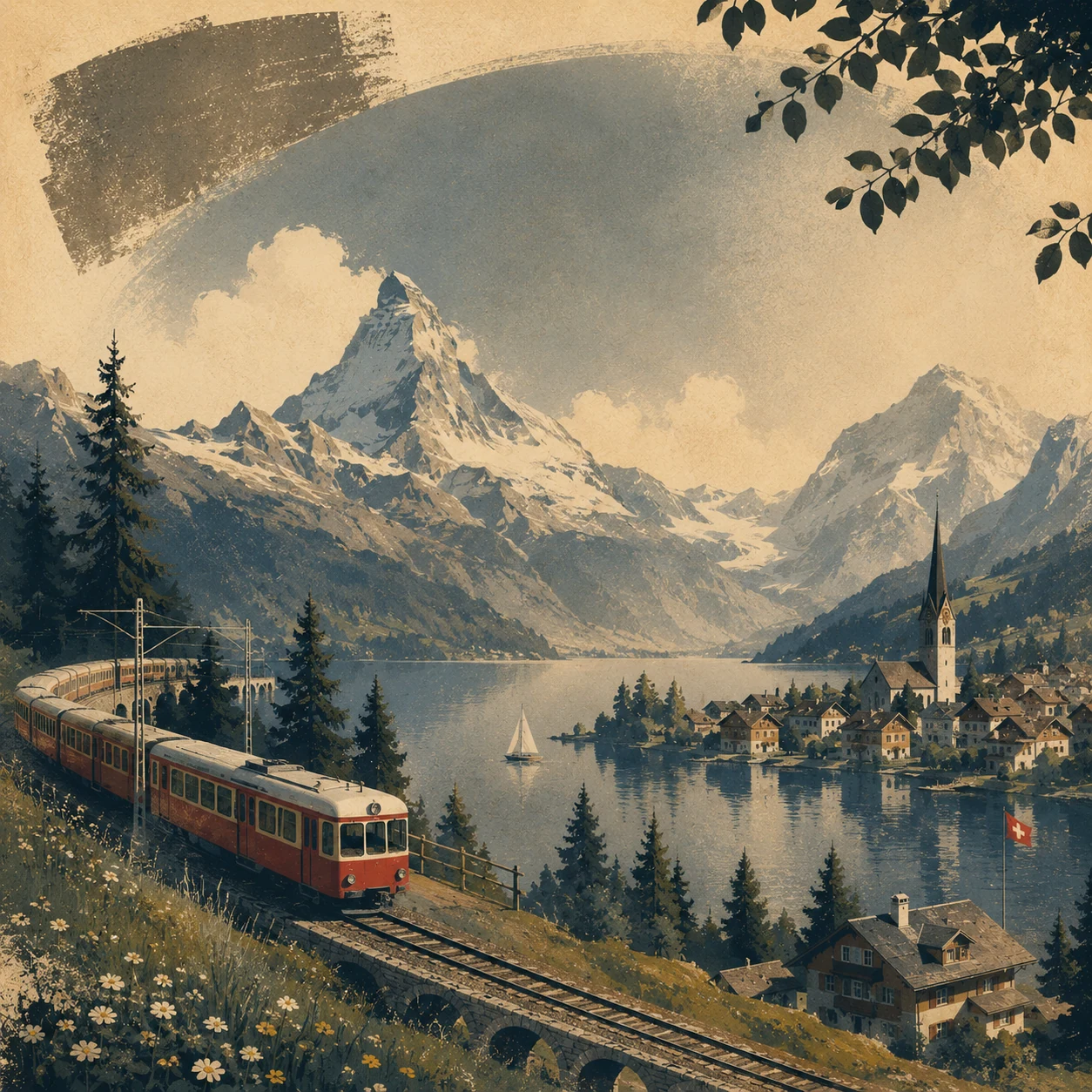
Switzerland appears coherent from a distance: punctual trains, immaculate landscapes and controlled prosperity. Up close, that coherence breaks apart. Zurich translates wealth into restraint; Lucerne stages the relationship between city, water and mountain; Geneva belongs as much to diplomacy and migration as it does to Switzerland; Lausanne rises vertically from lake to cathedral; Montreux turns the Riviera into music mythology; Gruyères compresses the medieval and pastoral into a remarkably complete image; Valais moves from vineyards and working valley towns to ski resorts that operate as international social systems. The country is not one culture but a sequence of compressed local worlds connected with unusual efficiency.
A country divided by language, water and altitude
Switzerland changes quickly. Language alters the social codes; altitude reorganizes the day; a lake can turn an inland city into something almost Mediterranean. The differences are compressed into short journeys: Zurich’s institutional confidence, Lucerne’s theatrical scenery, Geneva’s international gravity, Lausanne’s slopes, Montreux’s Riviera mythology and the vertical world of Valais.
Destination chapters
Destination
Zurich
Open guideZurich translates prosperity into restraint. Its strongest rooms rely on continuity, precision and social codes that rarely need to announce themselves. The city becomes most legible through its cultivated institutions: dining rooms preserved without becoming static, Italian traditions absorbed into local routine and nightlife contained behind an orderly commercial surface.
- Cantinetta AntinoriRestaurant
- KronenhalleRestaurant
- TaosRestaurant
- Le DézaleyRestaurant
- AuraRestaurant
- Swiss ChuchiRestaurant
- Baur’sRestaurant
- ContiRestaurant
Destination
Lucerne
Open guideLucerne is a postcard with a working interior. The lake, mountains and preserved center create an almost impossibly complete image, but the city becomes more interesting where that image is interrupted: French sociability beside the river, Italian continuity, contemporary grill rooms and rooftops that convert the Alps into nightlife scenery.
- Brasserie BoduRiverfront sociability
- Li Tai PeInherited room
- Osteria TiglioSocial memory
- PenthouseAfter dark
- AmpersandContemporary Lucerne
Destination
Geneva
Geneva faces outward. Diplomacy, migration, international institutions and grand hotels give it a formality that can obscure its more democratic life beside the water. The city’s identity is built from that tension: protocol and transience on one side, neighborhoods, swimming and public lake culture on the other.
Destination
Lausanne
Lausanne is organized through ascent. The lake, station, commercial center, cultural districts and old town occupy different levels, creating a city revealed through vertical movement. It feels younger and less ceremonially polished than Geneva, with academic life, nightlife and cultural institutions distributed across its slopes.
Destination
Montreux
Montreux is a resort city whose cultural identity escaped the resort. Grand hotels, the lake and the Riviera created the stage; music gave it mythology. Festival culture, landscape and hospitality remain difficult to separate, producing a town that feels simultaneously historic, seasonal and permanently cinematic.
Destination
Gruyères
Gruyères condenses several versions of Switzerland into one compact landscape: a medieval hill town, agricultural tradition, regional food mythology and an almost surreal collision between pastoral imagery and darker contemporary culture. Its power lies in how complete the composition feels, even when its elements seem incompatible.
Regional chapter
Valais
Valais is organized vertically. Vineyards cover the dry lower slopes; Sion and Sierre hold the civic and commercial life of the valley; schools and villages occupy the middle altitude; resorts sit above them, connected to international cultures of skiing, property and seasonal migration. The region moves constantly between local wine, practical valley life and expensive mountain theatre.
Destination
Crans-Montana and Bluche
Open guideCrans-Montana is not one resort but a long, horizontal social landscape. Crans carries polish and retail; Montana feels more practical and lived-in; Bluche introduces a hospitality-school world that rarely appears in luxury resort narratives. Its restaurants become seasonal institutions, repeated across ski days, long lunches, changing weather and evenings shaped by altitude.
- KaizenRestaurant
- Le MichelangeloRestaurant
- ZerodixRestaurant
- MerbéRestaurant
- Le ThaiRestaurant
- Moon BarBar
- Six Senses Crans-MontanaHospitality
- Monk’is BarBar
- Roots RestaurantRestaurant
- CaSyRestaurant
- Crans AmbassadorHospitality
- Le ChaletRestaurant
- New PubBar
Destination
Sion and Sierre
Sion and Sierre are the corrective to resort-only Valais. They contain the civic, commercial and wine cultures that keep the mountain destinations functioning. The resorts provide the image; the valley provides continuity.
Destination
Verbier
Verbier is an international social system laid over a mountain village. Skiing determines the daytime movement; restaurants, chalet dinners and bars determine how the evening fragments. Its most important addresses are not necessarily the grandest, but the ones that understand speed, appetite and the particular informality of an expensive resort.
- Shed BurgersAfter the mountain
Destination
Zermatt
Zermatt is a global luxury destination built around a village that still refuses the private car. Its force comes from that contradiction: electric vehicles, grand hotels and international dining move through streets where old timber buildings remain visible beneath the Matterhorn.
Destination
Champéry
Champéry is the quieter Alpine counterpoint. Its village structure remains legible while the mountain infrastructure connects it almost immediately to a much larger ski world. It offers access without fully surrendering its identity to resort scale.
Selected places across Switzerland
Kronenhalle
Le Dézaley
Brasserie Bodu
Osteria Tiglio
Penthouse
Le Michelangelo
Le Thai
Shed Burgers
Three modes of Swiss hospitality
Editorial group
Institutional Switzerland
- Restaurant
Kronenhalle
A Picasso hangs on the wall at Kronenhalle, along with originals by Chagall, Miró, Braque, Kandinsky, Giacometti and others, all displayed with the casualness normally reserved for coat hooks. Some entered the collection through Hulda and Gustav Zumsteg's friendships with the artists themselves; the restaurant became a meeting place for painters, writers, actors and musicians long before cultural relevance became part of restaurant branding. Underneath all this museum-grade material, people eat schnitzel, sliced veal, Chateaubriand and mousse au chocolat. Someone may be discussing the wine directly beneath several million francs of modern art. Kronenhalle puts art inside ordinary life and lets dinner continue around it.
- Restaurant
Cantinetta Antinori
Cantinetta Antinori brings Florence to Zürich. The Antinori and Bindella families had already worked together for decades when they opened this place in 1994, the first Cantinetta Antinori outside Italy. Thirty-two years later, Tuscan pasta, grilled meat, truffle when truffle makes sense and Antinori wines fill an old house just off Bahnhofstrasse. The chef has been with Bindella since the restaurant opened. Order the tagliolini al tartufo and an Antinori bottle. Zürich's efficiency can wait outside.
- Restaurant
Baur’s
Baur’s sits inside one of Zürich’s great hotels, with a private park, the lake nearby and decades of experience feeding important people. The brasserie has contemporary art by Louise Bourgeois, Rashid Johnson and others, proper European food and a serious bar. In 2026 the brasserie is undergoing another reset and reopens in October; the bar continues, because Zürich society cannot reasonably be expected to suspend aperitifs for construction. Use Baur’s when the evening needs polish more than ceremony.
- Restaurant
Le Dézaley
Fondue is ridiculous food. A communal pot of molten cheese arrives, adults begin spearing bread with long forks, somebody inevitably loses a cube and suddenly everyone at the table has become emotionally invested in recovering carbohydrates from dairy lava. Le Dézaley is exactly where this should happen. The room is dense, wooden and deeply Vaudois despite sitting beneath the Grossmünster in German-speaking Zürich. Chasselas flows, fondue dominates, sausages and rösti remain available for anyone whose evening requires additional structural reinforcement. One of the sayings traditionally associated with the place advises drinking the wine pure in the morning, without water at noon, and in the evening as God made it. Switzerland occasionally conceals excellent ideas beneath a reputation for moderation. Do not intellectualize the cheese. Stir. Dip. Drink. The system has already been perfected.
Editorial group
International Switzerland
- Inherited room
Li Tai Pe
Li Tai Pe belongs to an older European layer of Chinese dining: restaurants that became local through familiarity and longevity rather than through contemporary claims of regional authenticity.
- Restaurant
Kaizen
Miguel de Vega went to Japan in 2007 and apparently never completely came back. He trained seriously afterward, worked through high-level kitchens and keeps returning to Japan to follow what is happening there. He put the whole obsession inside a Swiss chalet on the road between Crans and Lens. Inside: otoro, uni, unagi, usuzukuri and Japanese products selected with the kind of fussiness that becomes reassuring once raw fish is involved. Outside: the Valais Alps. The sushi remains Japanese and the landscape remains Swiss. The two worlds sit next to each other without requiring a raclette maki to introduce them.
- Restaurant
Le Thai
At some point during a week in the Alps, cheese begins behaving aggressively. Then Le Thaï becomes important. Nitaya Faust has been cooking Thai food in Crans-Montana for years. Coconut, herbs, chilli, soups and spice bring an entirely different temperature into the week. The restaurant says the cooking has been adapted somewhat to European palates, but it has remained culturally recognizable while becoming locally habitual. Have the curry when the mountain has supplied enough fondue.
- Restaurant
Aura
Aura has an 800-degree grill, a smoker’s lounge, a bar, a club and an event hall currently preparing an Alice in Wonderland show. There is no useful minimalist interpretation available. The restaurant occupies the polished end of Zürich nightlife near Paradeplatz: steaks exposed to unreasonable heat, wine, suits, dresses, cocktails, then a club that operates until four when the calendar demands it. It gives people who have spent all week behaving professionally somewhere to stop doing that without dramatically changing clothes. Zürich built its corporate class a nightclub, and Aura delivers the full polished version.
- Restaurant
Taos
Tao’s is what Zürich’s banking district does once it has loosened the tie but has absolutely no intention of becoming bohemian. There is a restaurant, a garden hidden inside Augustinergasse, a bar, a lounge and a club downstairs. Dinner moves through broadly Asian territory; then the table begins absorbing cocktails, the bar becomes more relevant, somebody discovers ICON is open below and the distinction between eating and going out disappears. The group rebuilt the bar again in 2026 because even Zürich nightlife changes with the years. The garden is the best deception. Outside is Paradeplatz territory: banks, watches, extraordinary quantities of money behaving discreetly. Step through and everything softens. This is Zürich enjoying itself in the manner Zürich finds appropriate: beautifully dressed, highly organized and open until four.
Editorial group
Altitude and seasonal routine
- Restaurant
Le Michelangelo
Every ski resort needs one restaurant capable of absorbing six adults, three children, wet hair, somebody who wants pizza, somebody who wants fish and somebody who has been thinking about spaghetti since the second run of the morning. Michelangelo has been doing exactly that in Montana since 1998. It is not the restaurant you use to demonstrate your knowledge of Crans-Montana. It is the restaurant you return to because everybody at the table can stop negotiating. Wood-fired pizza. Pasta. Italian food. Wine. Done. A surprisingly large amount of civilization depends on restaurants that know how to be useful.
- Restaurant
Zerodix
The gondola closes. Zerodix begins. It sits directly at the bottom of the Crans–Cry d’Er lift, which means there is no awkward intermediate phase between skiing and après-ski. Boots remain on. Skis get abandoned nearby. The terrace fills. Music appears. Somebody who was discussing snow conditions fifteen minutes ago is now holding a vodka Red Bull in full ski equipment. This is one of the great efficiencies of mountain life. In good weather the terrace becomes a sun trap; later, DJs and live acts take over and the entire base station starts feeling less like the end of a journey and more like a minor festival with chairlifts nearby. Do not go home first. That would break the system.
- Restaurant
Merbé
Take the gondola. Get off halfway. Eat. Merbé sits around 1,950 metres at the intermediate station between Crans and Cry d’Er, which gives lunch a very specific pleasure: you are properly on the mountain but have not yet turned the meal into an expedition. On a clear day the terrace does most of the work. Peaks, valley, snow, enormous sky. Food arrives in the middle of it and suddenly taking public transport to lunch feels considerably more sophisticated than driving. Afterward there is an unusually good restaurant decision available: up or down.
- After the mountain
Shed Burgers
Shed Burgers understands the pace of Verbier: hunger after skiing, groups arriving at different times and evenings that may continue elsewhere. The food is universal; the role it plays is entirely specific to the resort.
Regional index
Zurich
08- Cantinetta AntinoriRestaurant
- KronenhalleRestaurant
- TaosRestaurant
- Le DézaleyRestaurant
- AuraRestaurant
- Swiss ChuchiRestaurant
- Baur’sRestaurant
- ContiRestaurant
Lucerne
05- Brasserie BoduRiverfront sociability
- Li Tai PeInherited room
- Osteria TiglioSocial memory
- PenthouseAfter dark
- AmpersandContemporary Lucerne
Crans-Montana
13- KaizenRestaurant
- Le MichelangeloRestaurant
- ZerodixRestaurant
- MerbéRestaurant
- Le ThaiRestaurant
- Moon BarBar
- Six Senses Crans-MontanaHospitality
- Monk’is BarBar
- Roots RestaurantRestaurant
- CaSyRestaurant
- Crans AmbassadorHospitality
- Le ChaletRestaurant
- New PubBar
Verbier
01- Shed BurgersAfter the mountain