Destination
China
Chongqing
China
Places to know
9 places
InterContinental Chongqing Raffles City
2 Changjiang Binjiang Road, Yuzhong District, Chongqing
The first useful thing this hotel does is remove the ground. You arrive at Raffles City, enter one of the towers, rise to the 42nd floor and only then find the lobby. Trees are growing indoors. The Yangtze and Jialing are far below. Depending on the weather, Chongqing either stretches endlessly into the hills or dissolves into atmospheric grey until towers seem to have been issued directly from the clouds. Breakfast happens at roughly the same altitude. The restaurants, bar and lobby lounge are up here too. Normal hotel geography, street, entrance, lobby, room, roof, has been discarded. The height briefly makes Chongqing legible. The two rivers explain the peninsula, bridges find their bearings, hills reveal themselves and roads appear to have some relationship to planning. Then you descend and, within twenty minutes, exit a building at what appears to be ground level only to discover another road several floors beneath you. The view offers a temporary diagram of a city that becomes wonderfully confusing again at street level.
Chaotianmen and Raffles City
Chaotianmen Square and Raffles City Chongqing, 2 Changjiang Binjiang Road, Yuzhong District
At the tip of Yuzhong, two enormous rivers meet and Chongqing has placed 1.127 million square metres of architecture directly on the point. There are eight towers. Two reach 350 metres. Across four of them, 250 metres in the air, Moshe Safdie placed a 300-metre glass structure called The Crystal containing gardens, restaurants, bars, an observation deck, a hotel lobby and a fifty-metre infinity pool. It is generally described as a horizontal skyscraper because apparently ordinary skyscrapers were no longer sufficient. The architectural explanation is that Raffles City evokes sails and Chaotianmen's history as a trading gateway at the confluence of the Yangtze and Jialing. Fine. The more immediate explanation is that somebody looked at one of the most dramatic pieces of urban geography in China and thought: more. And then, crucially, they built more. Seen from across the river, The Crystal looks faintly impossible. Seen from directly underneath, the scale becomes almost hostile. Seen from inside, you discover that this colossal object is also a shopping mall and people are buying sneakers. Chongqing has a special talent for making megastructures feel less like exceptional pieces of architecture than routine decisions that simply got slightly out of hand. Chaotianmen is where this becomes undeniable.
Hongyadong and Qiansimen Bridge
Hongyadong, 88 Jialing River Binjiang Road, Yuzhong District; Qiansimen Bridge begins immediately beside the complex
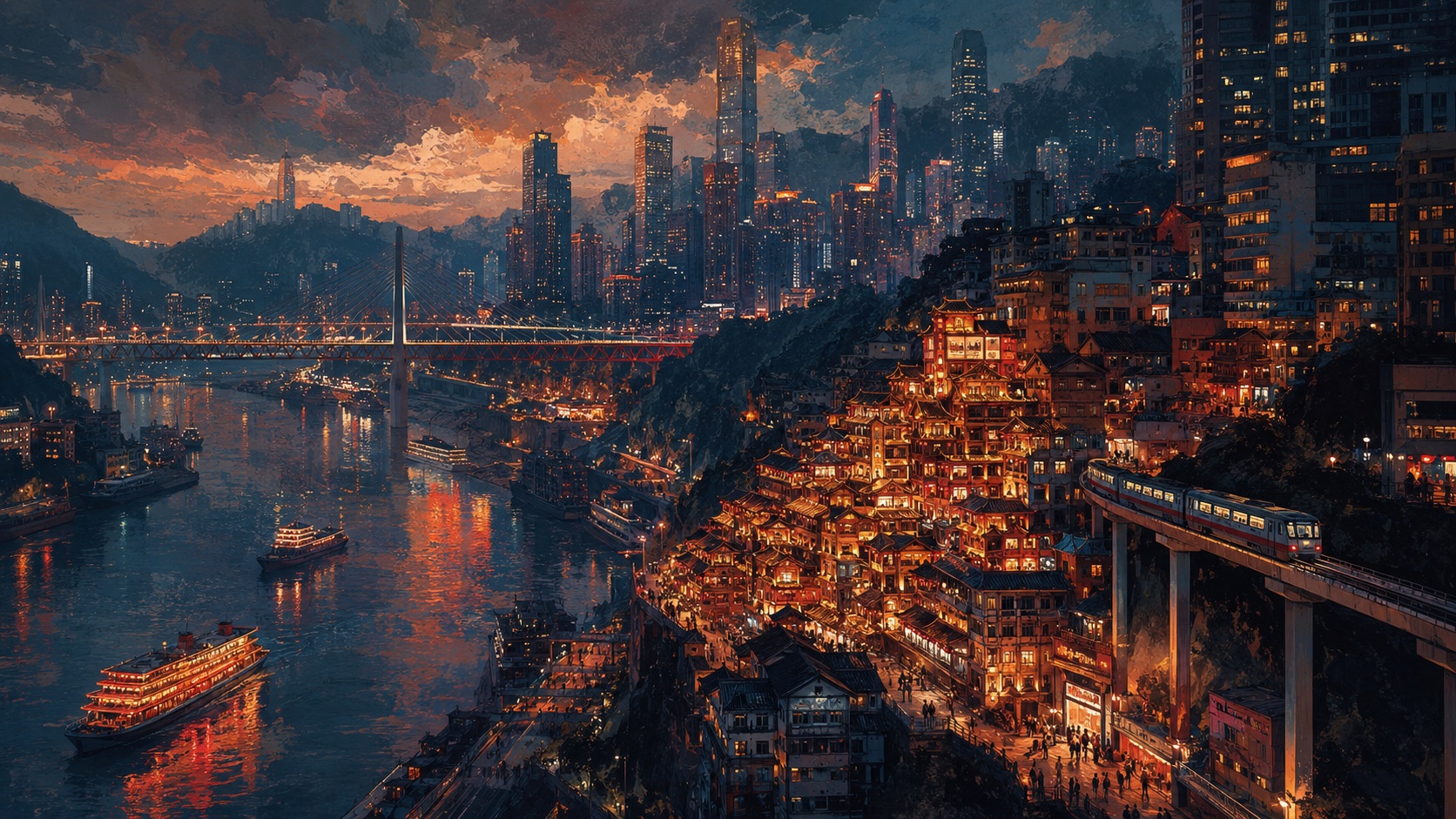
Hongyadong is not an ancient wooden town miraculously preserved in downtown Chongqing. The current complex opened in 2006 and reinterprets the cliffside diaojiaolou buildings that historically occupied this part of the city, using modern materials and commercial programming across a stack of levels that meet the city at different heights. Earlier stilt houses here had deteriorated as the old riverfront economy declined. The redevelopment was pushed by entrepreneur He Yongzhi, who reportedly won the project despite not being a conventional developer and nearly bankrupted herself building it. Go across Qiansimen Bridge after dark and look back. Hongyadong glows underneath the bridge in tiers of gold. High-rises rise behind it. Cars pass overhead. The Jialing catches the lights. What appeared from above to be street level is suddenly eleven stories in the air because another street exists at the bottom. The whole thing looks less like architecture than a city rendered with a software bug nobody wants fixed. It is commercial, reconstructed, wildly photographed and still astonishing. Look at the fucking thing.
Yangtze River Cableway
North station, 151 Xinhua Road, Yuzhong District; south station, 4 Shangxin Street, Nan’an District
The cableway opened in 1987 because people needed to cross the Yangtze. Its origin as public transport still gives the ride its clarity. For a few minutes the cabin leaves Yuzhong and hangs above the river. Apartment towers separate from one another. Bridges slide past. Boats become small. The enormous width of the Yangtze becomes obvious in a way it never quite does from the bank. Then you arrive on the other side. An ordinary crossing became one of the most magnificent ways to see Chongqing.
Shancheng Alley
Mountain City Alley, beginning around 234 Zhongxing Road, Yuzhong District
Begin walking. You are beside a wall. Then above a roof. Then looking at the Yangtze. Then the river disappears behind a house. Stairs. More stairs. Somebody has put a café into an old building. A narrow path continues around it. You follow the path and emerge somewhere that your map insists is several storeys away from where you are standing. The map has made a reasonable mistake. Shancheng Alley is part of an old pedestrian system connecting upper and lower Yuzhong, with sections tracing through Ming- and Qing-era urban fabric. A French missionary lit an early street lamp here around 1900; the route was later renamed Shancheng Alley in 1972. It still contains old residences and cliffside paths, although restoration has also introduced cafés, exhibitions, shops and, at one point, officially promoted “cyberpunk” installations because Chongqing is occasionally capable of parodying its own internet mythology before foreigners get the chance. Keep walking. The important thing is not whether every façade survived untouched. It is that the old pedestrian logic still forces the body to understand something maps flatten: Chongqing was built by people who treated a mountain as a perfectly acceptable place for a city and stairs as a perfectly acceptable substitute for negotiation. Eventually your legs will develop a position on this.
Guanyinqiao
Guanyinqiao Pedestrian Street and Guanyinqiao Square, Jiangbei District, Chongqing
At some point you should stop studying Chongqing and go to Guanyinqiao at night, where the city is busy being itself. The metro empties into crowds. Huge screens throw light across the pedestrian district. Shopping malls compete at a scale that makes the phrase shopping mall seem insufficiently militarized. Food stalls, restaurants, cosmetics, street fashion, couples, families, people livestreaming, teenagers apparently dressed for entirely different cities, and thousands upon thousands of people move through the same few blocks with no interest whatsoever in explaining Chongqing's history. There may be no ancient gate, important architect or UNESCO plaque. People come because there is shit to do, one of the fundamental purposes of cities and perhaps their most underestimated. Stay until the lights become normal.
Cyber Digital Plaza and Shiqiaopu Electronics District
Cyber Digital Plaza, 6 Yuzhou Road, Shiqiaopu, Jiulongpo District, Chongqing
There is a melancholy particular to old electronics markets. Not sadness exactly. More like encountering a machine whose original purpose disappeared but which nobody remembered to switch off. Shiqiaopu once concentrated an enormous share of Chongqing's computer trade. By 2011 the area's IT business was reportedly doing more than RMB10 billion annually. Towers and malls filled with computer sellers, parts dealers, cameras, cables, repair counters and the tiny specialist businesses that made buying a computer feel like entering a parallel economy. Then e-commerce swallowed much of the transaction and smartphones swallowed much of the object. Cyber Digital Plaza is still there, but the density has thinned. Some counters remain. Repair work survives. Components survive. On an upper floor, people still know exactly which obscure piece of plastic, silicon or wire has failed inside somebody else's machine. Go because the future already happened here and somebody is still repairing its past.
Pei Jie Hotpot
Jiaochangkou flagship, 1 Sixian Lane, Minsheng Road, Yuzhong District
Pei Jie opened in Jiaochangkou in 2013 with eleven tables in about ninety square metres. At its peak that tiny original operation was reportedly turning tables at a rate bordering on physical comedy; queues stretched for hours and the brand became known locally as a hotpot “queue king.” It later expanded well beyond Chongqing, but the origin remains wonderfully disproportionate to what followed. Eventually you sit down and a red pot arrives containing enough chilli, beef tallow and Sichuan pepper to make previous concerns seem abstract. Then come the things Chongqing hotpot expects you to stop being squeamish about: fresh tripe, duck blood, goose intestine, meat, vegetables, tofu, whatever else deserves several seconds in boiling fat before being retrieved with chopsticks. The first bite clarifies the cuisine's priorities very quickly, and the second confirms that moderation was never among them. By the middle of dinner, the room smells of beef fat, your clothes smell of beef fat, your hair has entered a long-term relationship with beef fat and somebody at the table is sweating from a part of the face not previously known to produce sweat. Order more goose intestine.
Yanshe Hotpot
Fourth floor, Sunshine 100 Liangjiang No. 1, Nanbin Road, Nan’an District, Chongqing
Yanshe performs a rather elegant act of heresy. It takes Chongqing hotpot, the great communal, oily, noisy, red-faced civic ritual, and gives everyone an individual pot. Then it adds wagyu. And Iberico pork. And seafood. And a window looking directly across the Yangtze toward Yuzhong and Raffles City. And somehow it remains hotpot. The Nanbin Road restaurant sits on the fourth floor of Sunshine 100, with polished service and river views; it has held Black Pearl One Diamond recognition in both 2025 and 2026. The menu can move from crisp goose intestine and tripe to imported beef, and there is, for reasons that become less unreasonable the longer one stays in Chongqing, a cheese Wagyu egg tart. Book after dark. The skyline across the river begins lighting up while the broth comes to temperature. Boats move along the Yangtze. Raffles City glows. A piece of wagyu disappears into chilli broth. Somebody retrieves goose intestine with a timer's precision. There is no contradiction to solve here. The vulgarity and the luxury like each other. The skyline and the hotpot like each other. Chongqing likes too much. Yanshe had the intelligence not to intervene.