Destination
China
Chengdu
China
Places to know
8 places
Upper House Chengdu
81 Bitieshi Street, Jinjiang District, Chengdu
Upper House Chengdu spent its first decade as The Temple House, a much better name for explaining the building and a considerably worse one for Swire's global brand architecture. In October 2025 the company unified its Houses under the Upper House name, changing the signs and telephone greetings while leaving the essential hotel intact. The property opened in 2015 as part of Taikoo Li, but you enter through Bitieshi, a restored Qing-dynasty courtyard building once associated with scholars and translators, then disappear into contemporary buildings, gardens and 100 unusually large rooms. The spa is buried beneath another heritage courtyard. Old stone walls sit beside MAKE Architects' modern volumes without either side being asked to impersonate the other. It is an unusually accurate introduction to Chengdu. The city can put a luxury hotel inside a historical precinct, a Buddhist temple beside global fashion and a subterranean pool underneath the whole arrangement without detecting a contradiction. The name changed; the physical idea survived.
Chengdu Research Base of Giant Panda Breeding
1375 Panda Avenue, Chenghua District, Chengdu
The giant panda has become so cute in popular culture that people occasionally forget it is an actual endangered animal. The Panda Base began in 1987 with six giant pandas rescued from the wild after widespread bamboo flowering contributed to a food crisis. It has since grown into a roughly 238-hectare research, breeding, conservation and education institution with a population now exceeding 270 giant pandas. The research institution came first; global celebrity became the operational complication. Then you see a panda sitting incorrectly and all intellectual seriousness briefly collapses. Go early, when the animals are more likely to be awake and before several thousand other people remember that pandas exist. The grounds are enormous, bamboo-heavy and closer to a wooded campus than the usual sequence of enclosures. Spend enough time there and the animal gradually recovers from the cartoon version of itself: solitary, specialized, evolutionarily improbable, difficult to breed and apparently capable of consuming bamboo while sitting like a middle-aged man watching television. China built an enormous scientific institution around saving them. Humanity responded by buying panda hats. Both facts are now part of Chengdu.
People’s Park and Heming Teahouse
People’s Park, 12 Shaocheng Road, Qingyang District, Chengdu
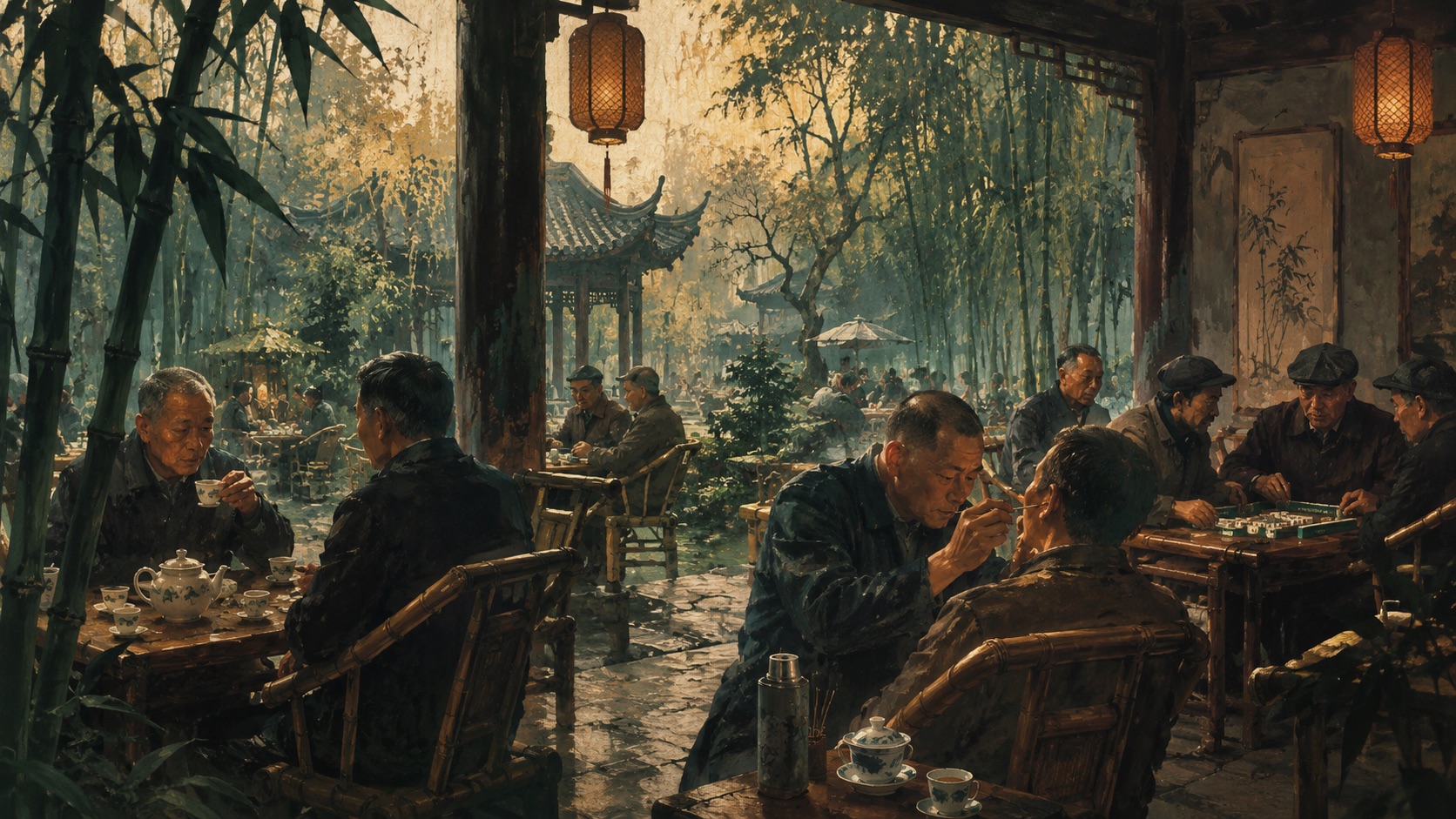
People's Park opened in 1911 as Shaocheng Park, Chengdu's first public park, on land belonging to the old Qing garrison city. It also contains the monument to the Railway Protection Movement, the Sichuan uprising whose suppression helped accelerate the revolution that brought down the Qing dynasty. This is all historically important. Nobody drinking tea appears especially hurried by it. Heming Teahouse arrived in 1923 and a century later the basic proposition remains gloriously resistant to optimization: sit beneath the trees, order gaiwan tea, talk, read, play cards, watch people, have your ears cleaned with terrifyingly long metal instruments if that seems like an intelligent decision, and allow an afternoon to disappear without producing anything measurable. Families do it. Retirees do it. Visitors do it badly for fifteen minutes and then begin understanding why everybody else has stayed. Chengdu is routinely described as laid-back, which is both true and dangerously close to travel-writing anesthesia. People's Park explains the more interesting version. Leisure here is not the absence of urban life. It is urban life: dense, public, social, noisy, intergenerational and conducted with surprisingly little guilt about productivity. Order more hot water. Your calendar stops mattering inside the park.
Kuanzhai Alley
Kuan Alley and Zhai Alley area, centred around 27 Kuan Alley, Qingyang District, Chengdu
The three surviving lanes of Kuanzhai Alley, Kuan, Zhai and Jing, trace back to 1718, when Qing authorities established a Manchu garrison in Chengdu's Shaocheng and laid out residential lanes for Banner soldiers. Most disappeared as the city changed; these three remained. A major restoration began in 2005, and the area reopened in 2008 as an extremely successful historic-commercial district filled with courtyards, teahouses, restaurants, snacks, shops and an enormous number of people taking essentially the same photograph. This is not an untouched Qing neighborhood miraculously overlooked by capitalism. Its value lies in what survives within the polished commercial version: the low courtyard scale, the old Shaocheng geometry, the sudden compression between lanes, and Chengdu's decision to keep the remnants of its Manchu garrison history in heavy contemporary use rather than reduce them to an archaeological footnote. Walk through the busy parts. Buy something unnecessary. Then slow down enough to inspect the courtyards and side passages. Restoration and tea shops do not erase the history underneath them.
Wuhou Tibetan Quarter
Wuhouci Hengjie and Wuhouci Cross Street, Wuhou District, south of Wuhou Shrine
A few streets south of Wuhou Shrine, Chengdu suddenly begins facing west. Wuhouci Hengjie, Ximianqiao Hengjie and the surrounding streets developed through a very particular geography of institutions and movement. Southwest Minzu University is nearby. So are offices representing Tibet and the Tibetan areas of western Sichuan. For decades Chengdu has functioned as a commercial, medical, administrative and transport gateway between the Sichuan Basin and the plateau; by the 1990s the neighborhood had developed into a major market for Tibetan goods, restaurants, medicine, books and religious objects. A 2022 field study counted more than 500 relevant shops across the wider district. Locals have sometimes called it Chengdu's own Barkhor. This is not a “Tibetan-themed street.” Please behave. Monks come to buy religious supplies. Traders sell clothing, books, jewelry and temple goods destined for Tibetan regions. Ingredients arrive from Ganzi and Aba. One reported shop even built a business selling 12,000-rpm electric butter churns manufactured in Chengdu and distributed across Tibet, which is a considerably more interesting expression of cultural exchange than another paragraph about prayer flags. Walk here because it changes the mental map. Chengdu is not merely a large Chinese city sitting comfortably inside the Sichuan Basin. It is also a hinge between the basin and the plateau, and these streets make that relationship physical. One city. Another geography suddenly visible inside it.
Taikoo Li and Chunxi Road
Taikoo Li, 8 Zhongshamao Street, extending west toward Chunxi Road, Jinjiang District
Chunxi Road was created in 1924 under Sichuan warlord Yang Sen and became one of Chengdu's major commercial streets. Almost exactly ninety years later, Taikoo Li opened beside it around Daci Temple, a Buddhist complex whose history reaches back roughly sixteen centuries and where Xuanzang received full ordination in 622 before eventually becoming the most famous Chinese pilgrim most people know primarily because later literature gave him a monkey. The contemporary arrangement is outrageous in the best possible way. Taikoo Li deliberately mixes restored heritage buildings, low-rise lanes, global luxury retail and the functioning temple. Its masterplan even distinguishes between “fast lanes” and “slow lanes”: international retail on one side of the logic, cafés, restaurants and smaller spaces on the other. There are six restored historic structures, direct metro access, underground parking and a gigantic bookstore buried inside the commercial machine. Then you walk several minutes toward Chunxi Road and the environment gets louder, taller, brighter and considerably less interested in architectural restraint. This is where anyone still carrying an image of Chengdu as a sleepy inland city should dispose of it properly. Fashion crowds. Giant digital façades. Street photographers. Luxury stores. Local brands. Teenagers dressed better than you. A Buddhist temple. Tea. Several hundred thousand people apparently free on the same Saturday evening. Do not choose between “historic Chengdu” and “modern Chengdu.” The city has declined the question.
The Bridge
66 Binjiang East Road, Jinjiang District, Chengdu
The Bridge occupies Anshun Bridge itself, one of the most forceful restaurant locations in Chengdu. The crossing has roots going back to the thirteenth century and appears in accounts associated with Marco Polo; floods eventually destroyed earlier versions before Chengdu rebuilt the bridge in the early 2000s. In 2017, founder Hebe Ni assembled André Chiang, Neri & Hu and an international bar consultancy to put ambitious contemporary Sichuan dining inside the landmark. Neri & Hu inserted a luminous interior into the historical shell, while Chiang's original food project and the current kitchen under executive chef Li Shunhong take Sichuan dishes, preserved techniques and occasionally obscure historical recipes through a composed fine-dining vocabulary. There are elaborate pickles, banquet logic and familiar street-food references subjected to interventions that would deeply confuse their original vendors. The kitchen gives the address substance, but the location remains impossible to ignore. After dark, the illuminated bridge, Jin River and city beyond become part of dinner. The restaurant has annexed a landmark, and then done enough cooking to deserve it.
Ma’s Kitchen / Ma Wang Zi
1 East Kangshi Street, Jinjiang District, Chengdu
Ma Wang Zi began in 1923 in Yongshou, Meishan, when founder Ma Shiheng sold blood-curd rice to boat haulers and porters who needed cheap food capable of doing actual physical work. The family is now in its fourth generation, the brand has crossed its centenary, received national China Time-honored Brand status and its Chengdu restaurant has acquired a Michelin star. The Chengdu room near Taikoo Li is considerably more polished than the original street operation, but the food has retained its force. The signature blood curd comes with pork offal and sliced eel. There is crispy fen zheng rou, dan dan noodles and Sichuan food that understands a century of history does not create an obligation to become delicate. Enough people agree that queues begin almost as soon as the doors open. One useful correction for anybody building a list: Ma's Kitchen is Ma Wang Zi. Michelin uses the English name; there is no mysterious second restaurant hiding beside it. One hundred years, four generations and several relocations have taken the business from street food to Michelin star, with the blood curd intact.