Destination
Norway
Oslo
Norway
Places to know
8 places
Dinner Nationaltheatret
Stortingsgata 22, 0161 Oslo
Dinner opened in central Oslo in 1989, serving Sichuan and Cantonese cooking built around the Chinese logic that several dishes become considerably more useful once several people are sitting around them. Thirty-seven years later, describing it simply as a Chinese restaurant in Norway begins to miss the more interesting thing that happened. Families came. Business dinners came. Celebrations accumulated. Generations learned the room. The restaurant became one of central Oslo's longstanding institutions while continuing to cook food whose origins are very clearly elsewhere. Cities work like this more often than cultural categories admit. Something arrives from somewhere else, people keep using it, decades pass and eventually the distinction between foreign and local stops explaining very much. Dinner demonstrates that process almost perfectly. After thirty-seven years, it is part of Oslo.
Solsiden
Akershusstranda 13, Skur 34, 0150 Oslo
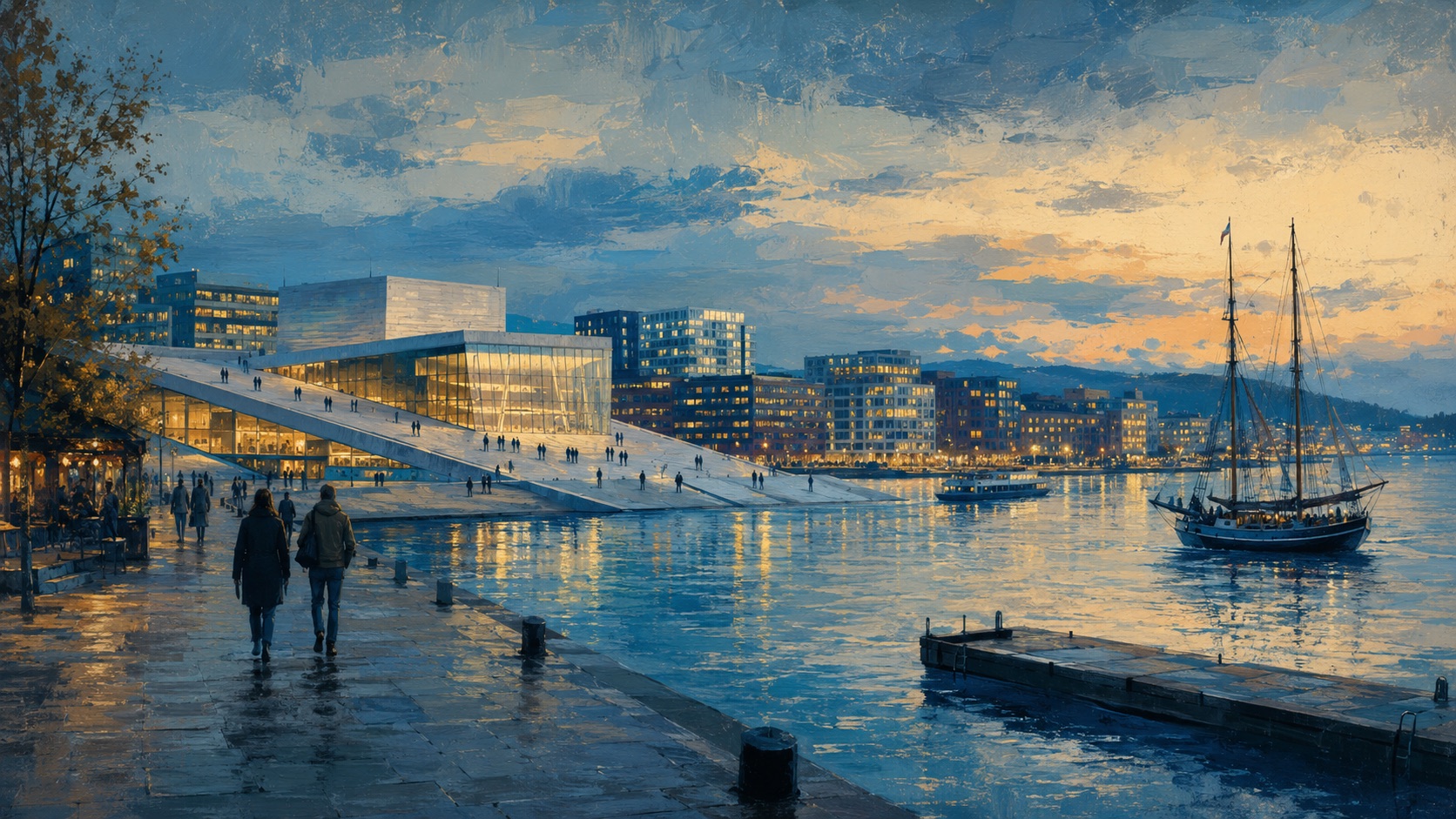
In 1993, Lars Jon Amundsen entered an abandoned soap factory in Shed 34 on Akershusstranda because he was organizing Oslo's first shellfish festival and needed electricity. He found the site for a restaurant instead. Amundsen already had form: in 1987 he had opened Oslo's first sushi bar. For Solsiden, he combined memories of casual waterfront restaurants in California, Parisian plateaux de fruits de mer and grilled fish around Vigo with an industrial shed directly on the Oslofjord. More than three decades later, the seafood platters remain enormous, the wine list runs into hundreds of bottles and the sliding windows open toward a harbour that performs increasingly unreasonable things with summer light. Solsiden exists for roughly four months a year. Oslo's summer is brief enough that people treat sunlight with the seriousness other cultures reserve for religion, so the restaurant opens when the city wants to be beside the water and closes when the argument becomes less convincing. Its short season concentrates the need for those long summer evenings.
Vigeland Park
Frognerparken, Oslo
Oslo has placed more than two hundred naked human beings in a public park and appears remarkably calm about the decision. Vigeland spent decades turning the entire human condition into bronze and granite: infants screaming, couples embracing, bodies fighting, ageing, dying, reproducing, clinging to one another and eventually climbing into the seventeen-metre Monolith, where 121 figures become one enormous vertical argument about being alive. Joggers, children, dogs and people eating lunch move around it. Snow lands on the sculptures. Someone checks a phone beneath a major meditation on mortality. Monumental art is usually protected by architecture and social expectation; here it shares territory with ordinary life until the distinction barely matters.
Fram Museum
Bygdøy · Bygdøynesveien 39, 0286 Oslo
Fridtjof Nansen looked at the long history of Arctic ships being crushed by ice and reached an unusual conclusion: everybody was fighting the ice incorrectly. Instead of building a ship that could resist pack ice through brute force, Nansen and shipbuilder Colin Archer designed Fram with a rounded hull intended to rise when the ice squeezed it. The basic plan was therefore to sail into the Arctic, deliberately become trapped, spend years frozen into the ocean and allow the ice itself to carry the expedition across the polar sea. This idea encountered objections. Nansen proceeded anyway. The ship worked. It later carried Otto Sverdrup through vast areas west of Greenland and then Roald Amundsen south for the expedition that reached the South Pole. Fram ultimately travelled farther north and farther south than any other wooden ship. And now the actual vessel sits inside the museum. Not a model. Not an immersive multimedia interpretation of a ship. The fucking ship. You can board it, enter the cabins, walk through the saloon, cargo spaces and engine room and suddenly understand that polar exploration involved real people deciding to spend several years inside a very small wooden object surrounded by an environment actively attempting to kill them. Fram belongs because the physical thing makes the insanity legible. Engineering is sometimes just unreasonable confidence that survived contact with reality. Norway has produced a suspicious amount of this.
Kon-Tiki Museum
Bygdøy · Bygdøynesveien 36, 0286 Oslo
Thor Heyerdahl presented academics with an unconventional theory about prehistoric travel from South America to Polynesia. They were unconvinced. One scholar essentially suggested that if he believed a balsa raft could cross the Pacific, he should go find out. Heyerdahl took the criticism literally. In 1947, six men and a parrot left Peru aboard Kon-Tiki. One hundred and one days later they reached Polynesia. The voyage demonstrated that such a journey was physically possible. It did not prove Heyerdahl's wider theory of Polynesian settlement, which later evidence has complicated considerably. Possibility is not the same as historical truth. The original raft now sits indoors in Oslo, still looking like a completely unreasonable object with which to cross an ocean.
MUNCH
Bjørvika · Edvard Munchs plass 1, 0194 Oslo
Edvard Munch made one of the most famous images in human history and was rewarded by having much of the rest of his career compressed into three words: The Scream guy. Munch left Oslo thousands of paintings, drawings, prints, photographs and objects. The museum exposes the much larger body of work beneath the celebrity image: jealousy, illness, sex, anxiety, death, love, self-portraiture, repetition and an artist who kept returning to the same emotional territory because apparently resolution was not required. Several versions of The Scream rotate because light would damage them if displayed continuously, meaning even global icons have to take shifts. Some of the monumental paintings are so large that conventional doors ceased being a useful architectural assumption. Munch's career exceeds both the image that made him famous and, at times, the building made to contain it.
MUNCH Restaurant
MUNCH, 12th floor · Edvard Munchs plass 1, 0194 Oslo
After several hours with Munch, go upstairs. From the twelfth floor, Bjørvika opens toward the fjord and across to Ekeberg, the landscape associated with the experience that eventually entered The Scream. Suddenly the art downstairs acquires geography. The city outside is no longer generic Oslo; it is part of the visual world you have just spent hours examining. Then somebody brings wine. This is probably enough curatorial interpretation for one afternoon.
HIMKOK
Storgata 27, 0184 Oslo
HIMKOK means moonshine. The name has since become slightly ironic because this alleged moonshine operation is currently ranked among the best bars on Earth. Behind an understated entrance on Storgata is a protected old building containing several drinking spaces, a cider operation, laboratories and, most importantly, a functioning micro-distillery producing its own aquavit, gin and vodka. The copper still downstairs is not decorative industrial heritage. It actually supplies the bar. This level of commitment would already be enough. HIMKOK kept going. Menus became design collaborations. Norwegian ingredients and spirits became the grammar rather than decorative Nordic references added to an international cocktail list. The building itself was reworked carefully enough to win the World's 50 Best Bars design award in 2024. The bar ranked No. 14 in the world in 2025 and No. 4 in Europe in 2026. What matters is that HIMKOK does not behave like an excellent cocktail bar that happens to be in Oslo. It takes Norwegian drinking culture, aquavit, preservation, ingredients, design and a slightly alarming enthusiasm for engineering and builds the entire bar around them. Some bars make cocktails. HIMKOK has built a place devoted to understanding what a Norwegian cocktail bar can be. The research is serious. The drinks are excellent.