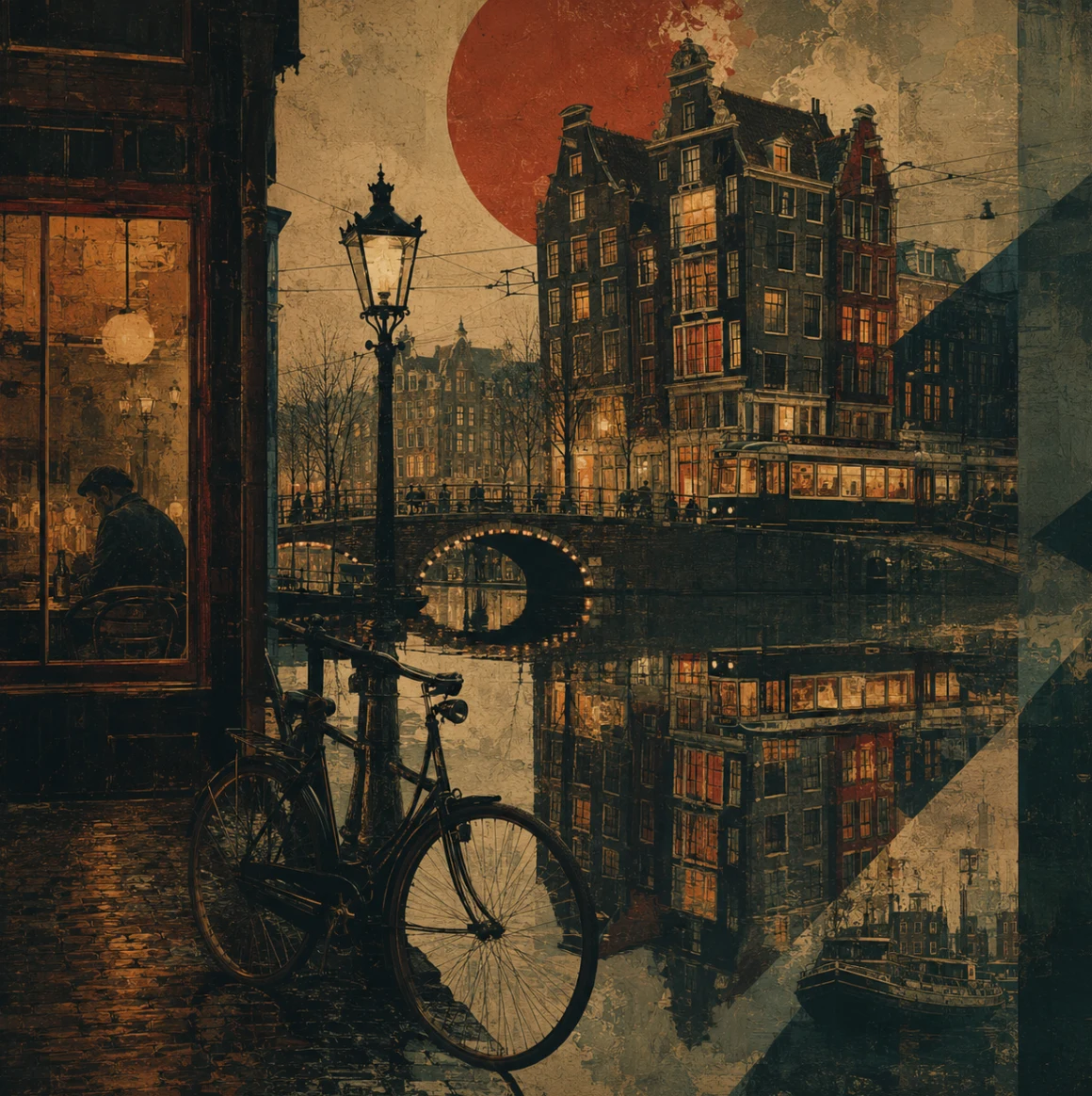
Historic centre / first access
The first door behind the façade
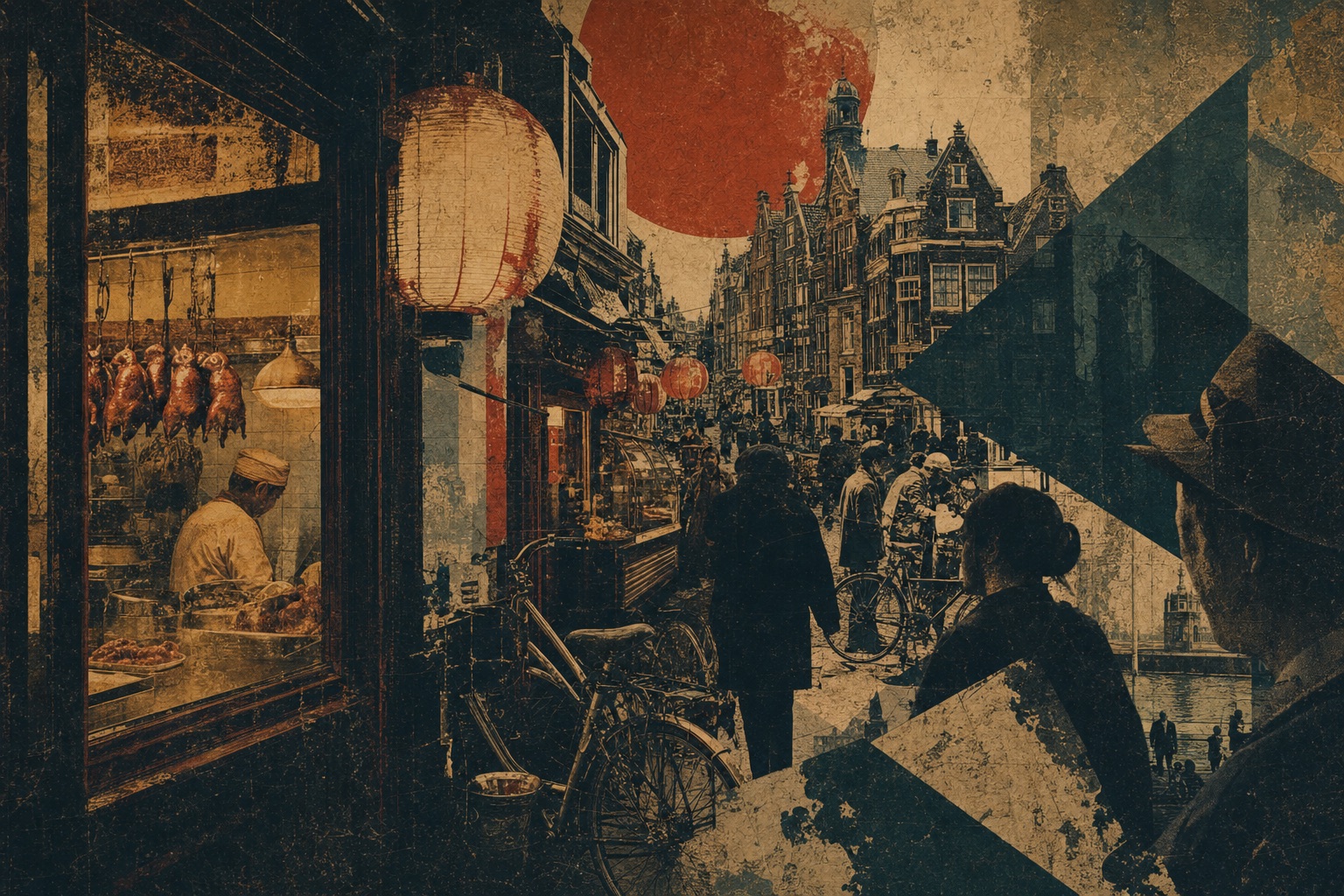
Zeedijk changes the reading. One of the oldest streets in the city carries Chinese, Thai, Surinamese, queer and maritime histories within walking distance of the postcard centre.
Since 1981
Nam Kee
Since 1981
Nam Kee
The original Zeedijk room entered Amsterdam’s cultural imagination without smoothing away its Cantonese identity. Its association with Kees van Beijnum’s novel and the film De Oesters van Nam Kee matters because a migration restaurant became material for the city’s own story.
Go when a direct, unfussy meal should reset the day. Continue south toward Nieuwmarkt.
Since 1998
Bird Thai
Since 1998
Bird Thai
Bird is the animated counterpoint: groups, close tables, speed and a street already crowded with competing appetites. Where Nam Kee reads as continuity, Bird reads as density, the multicultural centre widening in real time.
Better with several people and enough appetite for the room’s energy.
Food / market / migration
Elsewhere becomes local
Specific cultures become embedded here without first being reduced to a general idea of international food. Amsterdam gives obsessive projects a compact urban field in which to become part of daily life.
Sichuan Food
Sichuan Food
In 1993 it became the first Chinese restaurant in the Netherlands to receive a Michelin star, retaining the distinction for years. That recognition also exposes an older European habit: Chinese complexity became legible to institutions once translated into a formal fine-dining room. The current restaurant belongs in the file for the tension still held between regional specificity, history and a central Amsterdam setting.
Mangia Pizza & Wine da Antonio
Mangia Pizza & Wine da Antonio
A precise personal project rather than another vague performance of Italian authenticity. Neapolitan technique, flour, heat and the patience to repeat a narrow craft show how the city accommodates specialised forms of migration.
Garnachas y cotorreo
Tacoteca
Garnachas y cotorreo
Tacoteca
Its founder’s Ciudad Juárez background places the stall firmly in northern Mexico. Garnachas y cotorreo means market food with talk, joking and social noise around it: food, music, language and conversation operating together.
Tacoteca does not recreate Mexico by decorating a dining room to resemble it. It inserts Mexican hands, language, music and market food into the ordinary rhythm of Amsterdam. It is also the international closing point of the wider Changarreando story, while remaining fully intelligible on its own terms.
Go while Ten Katemarkt is active. The market rhythm is part of the meal.
People / style / permission
Cool without the announcement
Personal style matters more than visible status. Looking expensive matters less than appearing to know exactly what you like.
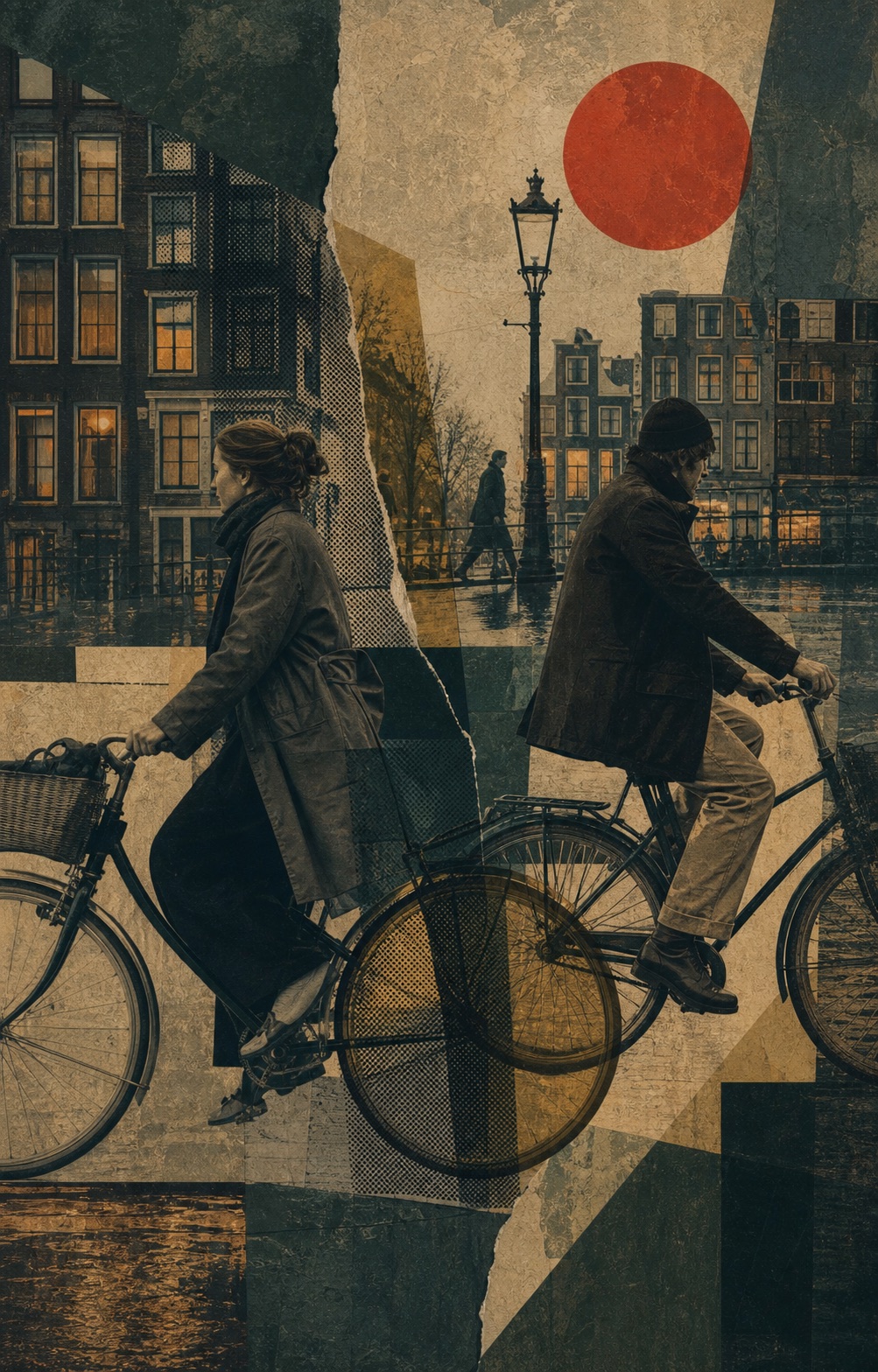
Considerable effort is visible, in the clothes, music, interiors, bicycles, food and bodies, but the final performance remains casual.
01 Cycling interrupts luxury’s theatre. Clothes must still move through rain, traffic and the ordinary city.
02 Vintage and contemporary fashion share the same body without requiring a label recital.
03 Queer and alternative communities alter the wider city’s codes; they are not decorative side programmes.
04 Chefs, DJs, designers, students, hotel workers and international residents repeatedly occupy the same rooms.
Primary stay
A hotel built around the table
Choose Zoku when the room needs to support work, cooking and a longer stay rather than traditional hotel ritual.
Zoku
Amsterdam
The Loft lifts the bed above a compact living space and makes a four-person table the centre of the room: a place to work, cook, eat or leave the day spread out.
Upstairs, coworking, a living kitchen, bar, communal tables, terraces and a greenhouse make the hotel useful beyond the room itself.
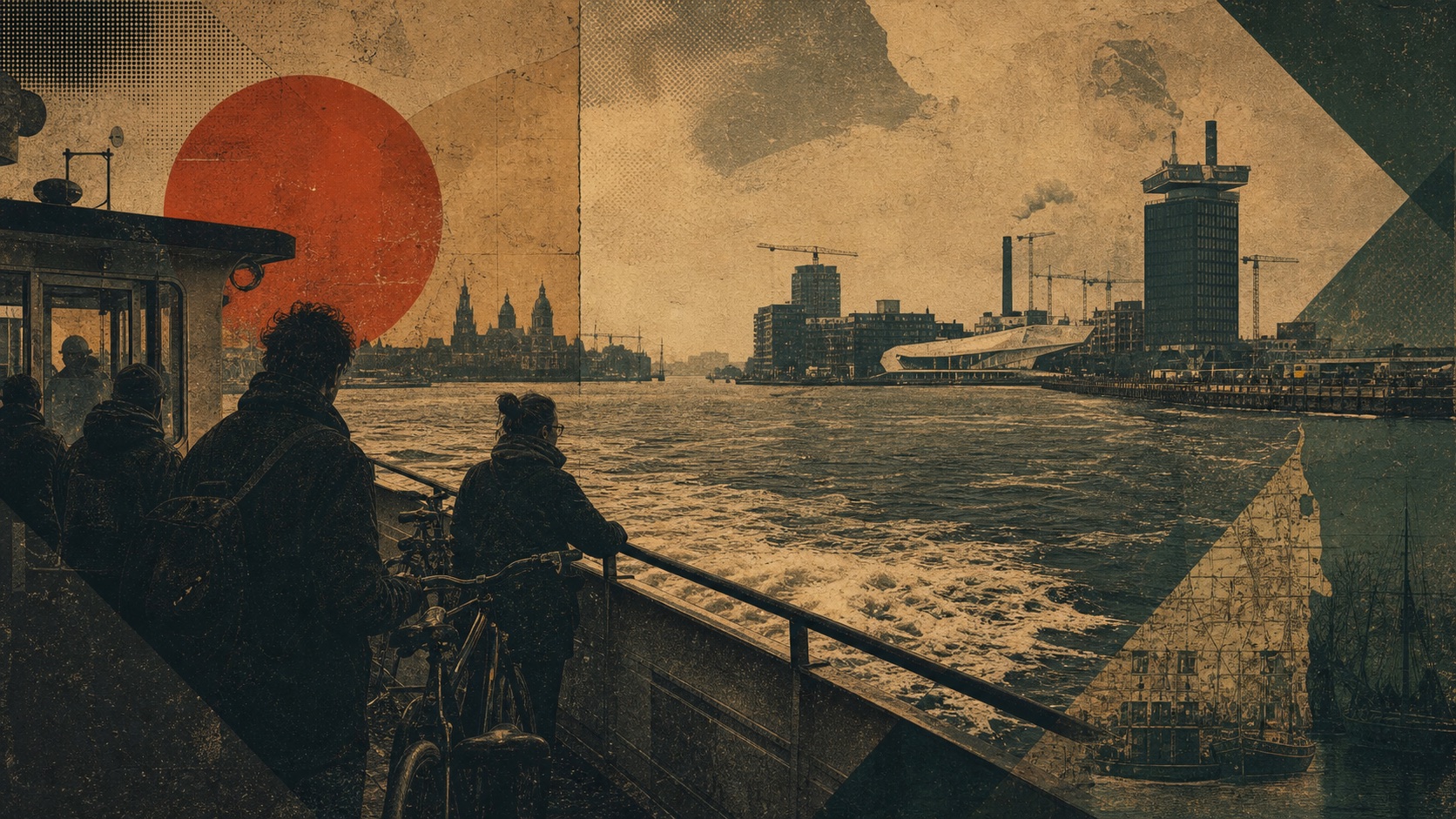
Water / spatial release
Cross the water
The centre falls away. The IJ opens. Amsterdam stops reading as a compact canal image and reveals its infrastructural scale.
Noord, before and after
Skatecafe Karin & Yvonne
Noord, before and after
Skatecafe Karin & Yvonne
Restaurant, bar, skating, music, gathering and nightlife remain visibly adjacent. That adjacency is the point: a looser and more social night emerging from Hamerkwartier rather than a room entered only after its transformation.
Arrive while the tables are still occupied. The transformation matters more than entering after it is complete.
Amsterdam after it stops being pretty
At night, visual prettiness is no longer the relevant measure. The elegant city seen at noon contains a large, ambitious electronic-music infrastructure at its edges.
Choose the event
RADION
Choose the event
RADION
RADION asks for commitment before the first track. Removed from the compact pleasures of the centre, its former ACTA complex uses concrete circulation and multiple rooms to support long-form programming. The journey west is part of the night.
Do not attend solely because the venue is famous. Read the programme; choose the sound and duration you actually want.
Read the room
RAUM
Read the room
RAUM
Music, cultural programming, community purpose, consent and safety form one proposition. RAUM’s queer identity is not an aesthetic layer offered for general consumption.
Inclusion does not mean treating every room as socially neutral.
Read the programme and house rules. Understand the event, arrive with respect for the community, and recognise that the door, music, code of conduct and identity belong together.
Closed / archivedAmsterdam night file 082016De School2024
Inside a former technical school, the club, restaurant, café, exhibitions, concerts and garden formed an interior city. Its closure did not end the expectation it created: Amsterdam nightlife could be ambitious enough to construct a world of its own.
RADION, RAUM and Skatecafe are not replacements. They are distinct institutions in the ecosystem that continues.
Enter the official digital archive ↗︎
The room becomes the night
Some Amsterdam restaurants matter because the room changes over the evening. Food begins the sequence; crowd, music and appetite decide when it ends.
Salmuera
Rozengracht · Latin American / mezcal · Essential
A historic Amsterdam drinking room now carries Latin American food and a serious mezcal programme. The evening is designed to lengthen, attracting an engaged social crowd without collapsing into the generic party-restaurant formula.
Book dinner when the next plan should remain undecided.
Brasserie Lolita
De Pijp · International social room
A highly composed room in which Amsterdam inhabits an imported French and New York-coded fantasy. The crowd and atmosphere are part of the reservation; the performance works because the city wears it lightly.
Pesca
Seafood · Participatory hospitality
Choosing from the fish-market display turns ordering into theatre. Its relevance is the visible mechanism, selection, negotiation, movement, not an automatic claim to the city’s best seafood.
The Seafood Bar
Fishmonger roots · Supporting
The concise contrast: family fishmonger roots developed into a polished, repeatable metropolitan seafood concept. Less participatory than Pesca, more immediately legible.
IZAKAYA
Sir Albert · Japanese / South American concept
Hotel-driven social Amsterdam: Japanese and South American references, a deliberately international crowd, and a clean shift from dinner toward night. It is not presented as a traditional Japanese izakaya.
MR PORTER
W Amsterdam · Steakhouse / rooftop / lounge
Included partly for who is in the room. The steakhouse, bar and rooftop are engineered to move toward nightlife; it is not the most locally rooted Amsterdam, but the social machine can be effective.
Jazz Café Alto
Korte Leidsedwarsstraat · Live jazz · Essential
Small, informal and long-running, Alto survives through repetition rather than reinvention. Musicians, audience and room press together; proximity is the whole architecture.
Go late and let it be the night’s last deliberate decision.